Safety – No fire or explosion risk There is no possibility of thermal runaway because of the SoNick battery characteristics and its chemistry is basically a non-flammable common salt. Lithium ion batteries can catch fire if they get too hot. They must be kept air conditioned at all times (which adds to running costs). You can’t put water on a lithium ion fire or the battery will explode. Fire brigade currently have no means to extinguish a lithium ion battery fire.No gas emissionsLead acid batteries, in particular give off hydrogen and must be kept in a fireproof enclosure that will prevent any sparks from igniting the batteries. This also applies to lithium ion to a lesser extent. Redflow has the risk of a chemical spill (toxic bromine) although this is low.
Application – Off-grid
Location – Kinglake, Victoria
System Objective – The client had lost his previous home on Black Saturday so the solar and storage system must survive and operate at extreme temperatures. It also fits with the ethos of a home with sustainability as its cornerstone.
Commissioned – May, 2015
Installed PV – 5 kW
Useable battery storage – 15.36 kWh
Designed and installed by – Ian Conibeer, Energy Connections
Lithium-ion battery storage devices – including Tesla Powerwalls and other products – may be effectively banned from being installed inside homes and garages in Australia under new guidelines being drafted by Standards Australia.
The move, if upheld, is likely to send shockwaves through the industry, with thousands of Australian households, including prime minister Malcolm Turnbull, already installing lithium ion battery storage devices and millions more predicted to do so in coming years.
Standards Australia, a voluntary body that draws on expertise from the industries involved and key stakeholders, is expected to release the draft guidelines in the next week or so. But news of its proposals has already leaked, causing concern that the decision could bring the industry to a halt.
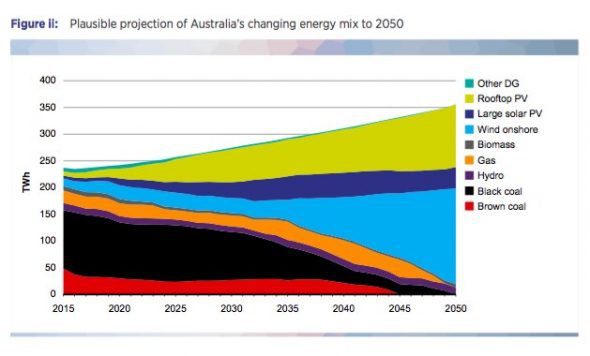
A major new study by the CSIRO and the main networks lobby says a decarbonised energy grid by 2050, with half of generation produced and stored locally, will save billions in upfront capital costs and consumer bills, and deliver a secure electricity system.
(See also out story CSIRO, networks put lie to conservative campaign against wind and solar).
In a direct rebuff to the renewable energy scare campaign and myth-making being played out in the political arena, the premier scientific body and Energy Networks Australia say that wind and solar will provide nearly all our electricity needs by 2050, and the system will be cheaper for all customers.
Large energy users, battery storage developers and some small energy retailers are pushing for a change in energy market rules that could have dramatic consequences for the industry – levelling the playing field for battery storage, lowering prices for consumers, and wresting control of the energy markets from the big generators.
Soaring wholesale prices have become a major issue in Australia in recent months, defying logic (analyst David Leitch has described them as absurd), and raising concerns among many energy consumers.
The finger has been pointed at the bidding patterns of some major generators, which is one of the main reasons why the South Australian government wants to build a new cable to the eastern states, because it says it has “lost control” of energy pricing. (Although some media chooses to blame renewables).
The proposal to change a relatively obscure rule in the running of the energy markets is seen as an opportunity to wrest control from big, bulky, slow-response generators and encourage smarter, smaller, fast-response distributed generation, particularly battery storage and software for energy management systems.
The proposal comes from zinc smelter operator Sun Metals, which has asked the Australian Energy Market Commission to change the rule. Currently, pricing is set every five minutes, but financial settlement is made only every 30 minutes. Even the AEMC admits that this can distort the market, and push up prices unnecessarily.
An example is illustrated in the graph below, which explains why operators of big generators, particularly gas or diesel-fired peaking plants, may object to the rule change.
There are lots of pieces in the puzzle of combating climate change and every little bit helps and most of the actions taken are by people taking a stand and taking action.
It goes beyond building environmentally friendly buildings with renewable energy, including storage to all aspects of your life including your diet.
There are so many great ways to contribute to a healthy planet. Some steps are larger than others; some are quick and some eco-friendly ideas take substantial planning. We’ll eventually talk about all these ideas at length but just to get you thinking here are 100 various ideas that can help your family go green.
Randall Munroe posted an XKCD comic that so perfectly sums up the illogical nature of the most pervasive argument against the existence of man-made global warming: “The climate has changed before.”
Let me complete that fallacy with its obvious conclusion: The climate has changed before, therefore man cannot be causing the climate to change now. This is kind of like saying “Wildfires have happened naturally before, so man cannot cause a wildfire.”
Yes, Earth’s climate has waffled around for as long as the planet has existed. But it has happened slowly over the course of millennia. Right now, our climate is changing faster than it ever has in 22,000 years, and we know why: we’re pumping carbon dioxide and other greenhouse gas into the atmosphere. We have known that these gases cause warming since the early 19th century. This is not a new science. But for some reason we’re still arguing about it.
Enough from me, though. Please just consider this comic. I hope you find it as funny and thoughtful as I did.
The Best Form of Energy Efficiency is to Use the Free Energy of the Sun.
There are lots of pieces in the puzzle of combating climate change and every little bit helps and most of the actions taken are by people taking a stand and taking action.
It goes beyond building environmentally friendly buildings with renewable energy, including storage to all aspects of your life including your diet.
There are many features that can be included when designing and building a home to be sustainable or environmentally friendly. The following list gives many features that when incorporated can greatly increase star ratings and make a house much friendlier to live in. As an added bonus, heating and cooling costs are reduced which also reduces the impact on the greater environment.
Different climates will need an emphasis on different areas like window size and insulation so make sure you understand your area when designing your house. The list below works well in the cooler southern states of Australia.
It’s not technology or science that is going to save us on this planet.
What will save us is the ethical transformation of our societies.
This is so true and why we see so much interest in community power and so much other grassroots action. This is why, in Australia, domestic solar and energy storage is growing so much faster than government projects.
It’s time to transform energy generation in your society. Do your bit.
As Margaret Mead says “Never doubt that a small group of thoughtful, committed citizens can change the world; indeed, it’s the only thing that ever has”
A ReachTEL poll commissioned by Friends of the Earth shows 68% of the state, including a majority of Liberal voters, want to see an end to reliance on coal.
Hazelwood power station in Victoria’s Latrobe Valley is one of the dirtiest power generators in Australia. A majority of Victorians would now like to see a shift away from coal power towards solar, wind and other renewables. Photograph: David Crosling/AAP
The vast majority of people in Victoria – and even a majority of Liberal voters – support the state moving towards 100% renewable energy “as a matter of urgency,” a new poll has found.
The polling comes as the state government works to rewrite the Climate Change Act, including pre-2050 emissions reduction targets.
More than 68% of Victorians said they agreed or strongly agreed that “Victoria needs to transition its energy use from coal to 100% renewables as a matter of urgency”, according to the ReachTEL poll of 1,137 people conducted on 4 August and commissioned by Friends of the Earth.

 There is no possibility of thermal runaway because of the SoNick battery characteristics and its chemistry is basically a non-flammable common salt. Lithium ion batteries can catch fire if they get too hot. They must be kept air conditioned at all times (which adds to running costs). You can’t put water on a lithium ion fire or the battery will explode. Fire brigade currently have no means to extinguish a lithium ion battery fire.
No gas emissions
Lead acid batteries, in particular give off hydrogen and must be kept in a fireproof enclosure that will prevent any sparks from igniting the batteries. This also applies to lithium ion to a lesser extent. Redflow has the risk of a chemical spill (toxic bromine) although this is low.
There is no possibility of thermal runaway because of the SoNick battery characteristics and its chemistry is basically a non-flammable common salt. Lithium ion batteries can catch fire if they get too hot. They must be kept air conditioned at all times (which adds to running costs). You can’t put water on a lithium ion fire or the battery will explode. Fire brigade currently have no means to extinguish a lithium ion battery fire.
No gas emissions
Lead acid batteries, in particular give off hydrogen and must be kept in a fireproof enclosure that will prevent any sparks from igniting the batteries. This also applies to lithium ion to a lesser extent. Redflow has the risk of a chemical spill (toxic bromine) although this is low. 
 The move, if upheld, is likely to send shockwaves through the industry, with thousands of Australian households, including prime minister Malcolm Turnbull, already installing lithium ion battery storage devices and millions more predicted to do so in coming years.
Standards Australia, a voluntary body that draws on expertise from the industries involved and key stakeholders, is expected to release the draft guidelines in the next week or so. But news of its proposals has already leaked, causing concern that the decision could bring the industry to a halt.
The move, if upheld, is likely to send shockwaves through the industry, with thousands of Australian households, including prime minister Malcolm Turnbull, already installing lithium ion battery storage devices and millions more predicted to do so in coming years.
Standards Australia, a voluntary body that draws on expertise from the industries involved and key stakeholders, is expected to release the draft guidelines in the next week or so. But news of its proposals has already leaked, causing concern that the decision could bring the industry to a halt. 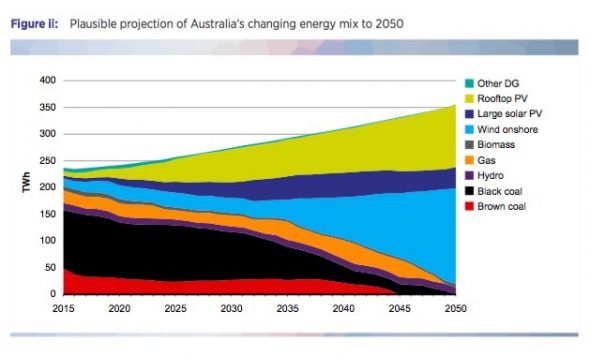 A major new study by the CSIRO and the main networks lobby says a decarbonised energy grid by 2050, with half of generation produced and stored locally, will save billions in upfront capital costs and consumer bills, and deliver a secure electricity system.
(See also out story CSIRO, networks put lie to conservative campaign against wind and solar).
In a direct rebuff to the renewable energy scare campaign and myth-making being played out in the political arena, the premier scientific body and Energy Networks Australia say that wind and solar will provide nearly all our electricity needs by 2050, and the system will be cheaper for all customers.
A major new study by the CSIRO and the main networks lobby says a decarbonised energy grid by 2050, with half of generation produced and stored locally, will save billions in upfront capital costs and consumer bills, and deliver a secure electricity system.
(See also out story CSIRO, networks put lie to conservative campaign against wind and solar).
In a direct rebuff to the renewable energy scare campaign and myth-making being played out in the political arena, the premier scientific body and Energy Networks Australia say that wind and solar will provide nearly all our electricity needs by 2050, and the system will be cheaper for all customers. 
 It goes beyond building environmentally friendly buildings with renewable energy, including storage to all aspects of your life including your diet.
There are so many great ways to contribute to a healthy planet. Some steps are larger than others; some are quick and some eco-friendly ideas take substantial planning. We’ll eventually talk about all these ideas at length but just to get you thinking here are 100 various ideas that can help your family go green.
It goes beyond building environmentally friendly buildings with renewable energy, including storage to all aspects of your life including your diet.
There are so many great ways to contribute to a healthy planet. Some steps are larger than others; some are quick and some eco-friendly ideas take substantial planning. We’ll eventually talk about all these ideas at length but just to get you thinking here are 100 various ideas that can help your family go green.

 It’s not technology or science that is going to save us on this planet.
What will save us is the ethical transformation of our societies.
This is so true and why we see so much interest in community power and so much other grassroots action. This is why, in Australia, domestic solar and energy storage is growing so much faster than government projects.
It’s time to transform energy generation in your society. Do your bit.
As Margaret Mead says “Never doubt that a small group of thoughtful, committed citizens can change the world; indeed, it’s the only thing that ever has”
It’s not technology or science that is going to save us on this planet.
What will save us is the ethical transformation of our societies.
This is so true and why we see so much interest in community power and so much other grassroots action. This is why, in Australia, domestic solar and energy storage is growing so much faster than government projects.
It’s time to transform energy generation in your society. Do your bit.
As Margaret Mead says “Never doubt that a small group of thoughtful, committed citizens can change the world; indeed, it’s the only thing that ever has”